Dussehra Story for Kids
— The Day Good Won.
Every October, enormous figures of a ten-headed king are built in parks across India and then set alight. It is loud, it is bright, and it is a great deal for a small person to take in. The story underneath it is much quieter than the fireworks suggest.
Dussehra, also called Vijayadashami, closes the nine nights of Navratri. It marks the day Rama finally brought Sita home. Told well, it is not a story about a battle at all — it is a story about keeping a promise, and about how many small helpers it takes to keep one.
The short version, for right now
If your child is asking this minute and you have thirty seconds: a king called Ravana took Rama's wife Sita away. Rama and a great many friends went to bring her back, and on this day they did. We light the effigy to say that the stubborn, unlistening part of a person does not win in the end.
The story of Dussehra, the bedtime way.
There was a prince called Rama who was sent away from his kingdom for fourteen years, and who went without arguing. His wife Sita went with him, and so did his younger brother Lakshmana. They lived in the forest, and for a long while they were happy there.
Far to the south lived a king named Ravana. He was not stupid and he was not ugly — he was clever, and learned, and he had studied a great many things. He was also a person who had stopped listening. One day he decided he wanted Sita, and because he had stopped listening, he simply took her.
Rama went to find her. He could not do it alone, so he asked for help, and the help came from everywhere — from Hanuman, who could leap further than anyone thought possible, from an army of bears and monkeys, and famously from one very small squirrel who carried one very small pebble to a bridge that needed building. Nobody told the squirrel it was too small to matter.
On the tenth day, Rama reached Ravana, and Sita came home. That tenth day is Dussehra. The tall figures burned in October are Ravana, and what we are really saying as they burn is that the part of us that will not listen — the anger, the pride, the wanting — does not get the last word.
If the effigy frightens them
Many young children find the burning genuinely alarming, and that is a reasonable thing to find alarming. It helps to say what it is before you go: it is not a person, it is a paper giant, and we are all shouting because we are glad. Watching from a distance, or from a balcony, is a perfectly good way to attend.
Press play, tonight.
The whole story, narrated, free, no sign-up. English or Hindi here; Hinglish, Tamil, Telugu, Bengali and Marathi inside the app — and in StoryVeda a personalised story can have your own child's name inside it.
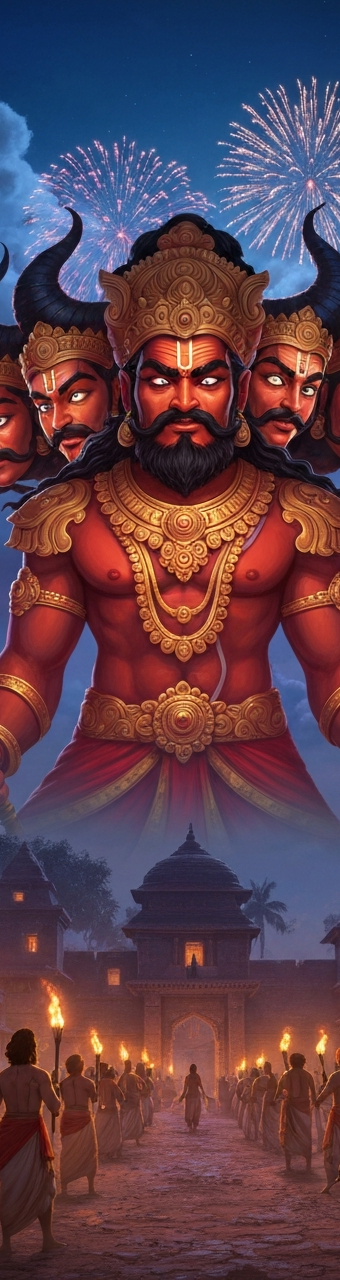
Dussehra: The Day Good Won
Festivals of Bharat · ages 4–9 · 4 min
More of the same story, also narrated and free: Meeting Prince Rama (ages 3–7), where Hanuman and Rama meet for the first time, and Rama and the Bridge of Squirrels (ages 3–9), which is the squirrel's side of it. Both sit in the Festivals of Bharat collection.
Nine nights, then the tenth day.
Dussehra does not stand alone. It closes Navratri, which runs 11–19 October in 2026, and it opens the road to Diwali twenty days later — the night Rama finally reached home and the lamps were lit for him. Told together, the three make one story rather than three separate festivals, which is usually easier for a child to hold.
Dussehra, briefly answered.
What is the story of Dussehra for children?
Prince Rama's wife Sita was taken away by a king called Ravana, who had ten heads and would not listen to anyone. Rama, his brother and a great many friends — including Hanuman and a very small squirrel — travelled a long way to bring her home. Dussehra is the day they succeeded. For a child it lands best as a story about keeping a promise and not giving up.
How do I explain Ravana to a young child?
Not as a monster. Ravana was clever and learned, and he still made a choice that hurt someone. His ten heads are easiest to explain as ten things he wanted all at once — anger, pride, greed — and none of them would let him stop. That makes the burning effigy far less frightening: we are letting go of the things inside us that will not listen.
Is there a Dussehra story in Hindi for kids?
Yes. “Dussehra: The Day Good Won” is narrated in Hindi as well as English, and you can play it on this page without downloading anything. In the StoryVeda app it is also available in Hinglish, Tamil, Telugu, Bengali and Marathi.