Nine nights, and a girl
who learned to dance.
Navratri is loud, late and full of adults. For a small child it is either the best week of the year or nine evenings of being carried around a hall at bedtime. Which one depends almost entirely on how it is explained.
Nine nights of Maa Durga, garba evenings, and children asking “why do we celebrate Navratri?” — this is the perfect week for a bedtime story that answers them gently. StoryVeda's Navratri stories are made for ages 2–12, told the calm, screen-light way — in English, Hindi, Hinglish, Tamil, Telugu, Bengali or Marathi.
Sharad Navratri 2026 runs from Sunday 11 October to Monday 19 October, with Dussehra on 20 October.
The short version, for right now
If your child is asking this minute and you have thirty seconds: Nine nights of celebrating Durga, a goddess who is strong and brave. People dance, wear a different colour each day, and some people fast.
The same festival, three different explanations.
The commonest mistake is telling a four-year-old the version written for a nine-year-old, then wondering why they wandered off.
What to say to a 3–5 year old
"Nine nights of dancing, and each night has its own colour." Colour is something a three-year-old can participate in immediately. Let them pick the clothes.
What to say to a 6–8 year old
Introduce Durga as strong rather than fierce. A goddess with many arms who defeated something frightening is a very good bedtime idea for a child who is scared of the dark.
What to say to a 9–12 year old
Nine forms, nine qualities — courage, patience, knowledge. This is the age where a child can be asked which quality they would want, and will give you an answer worth hearing.
Three things that actually work.
- Follow the colour of the day. It costs nothing and gives a young child a role.
- Ten minutes of garba at home beats three hours at a venue past bedtime.
- If you fast, explain it rather than hiding it. Children notice adults not eating and invent worse explanations than the truth.
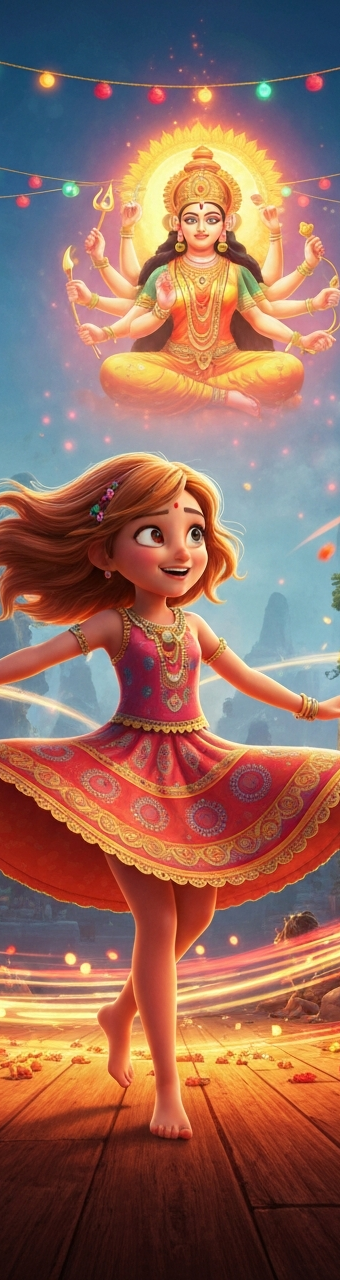
“Navratri: The Girl Who Learned to Dance”
This Navratri story is in StoryVeda's Festivals of Bharat collection — narrated, illustrated, and available in English, Hindi, Hinglish, Tamil, Telugu, Bengali or Marathi. It is in the free library.
Festival stories arrive the week they matter, not months later. That is the whole reason the collection exists.
Stories your child can hear this Navratri.
All of them narrated, all of them free to listen to, all of them in seven languages.
-
 Navratri: The Girl Who Learned to Dance
Ages 3–12 · 5 min
Siya cannot do garba and wants to give up — until her mother explains that the dance was never about the steps. -
 Dussehra: The Day Good Won
Ages 4–9 · 4 min
Why the tall effigies burn, told as a story about the choices we make rather than a battle. Full page: the Dussehra story for kids. -
 Meeting Prince Rama
Ages 3–7 · 7 min
The friendship that begins everything — Hanuman meets Rama, and one kind hello changes a whole life. -
 Rama and the Bridge of Squirrels
Ages 3–9 · 3 min
A very small squirrel carries a very small pebble, and learns that every sincere effort counts.
Navratri, briefly answered.
What is Navratri in simple words for children?
Nine nights of celebrating Durga, a goddess who is strong and brave. People dance, wear a different colour each day, and some people fast.
When does Navratri start in 2026?
Sunday, 11 October 2026, running for nine nights.
How can young children take part in Navratri?
Let them choose the colour of the day, dance for ten minutes at home rather than staying out late, and give them one small job in the puja.
What is the story behind Navratri?
Durga fought and defeated the buffalo demon Mahishasura over nine nights. For children it works best as a story about being brave for longer than you thought you could.
More festivals: Raksha Bandhan · Krishna Janmashtami · Ganesh Chaturthi · Diwali