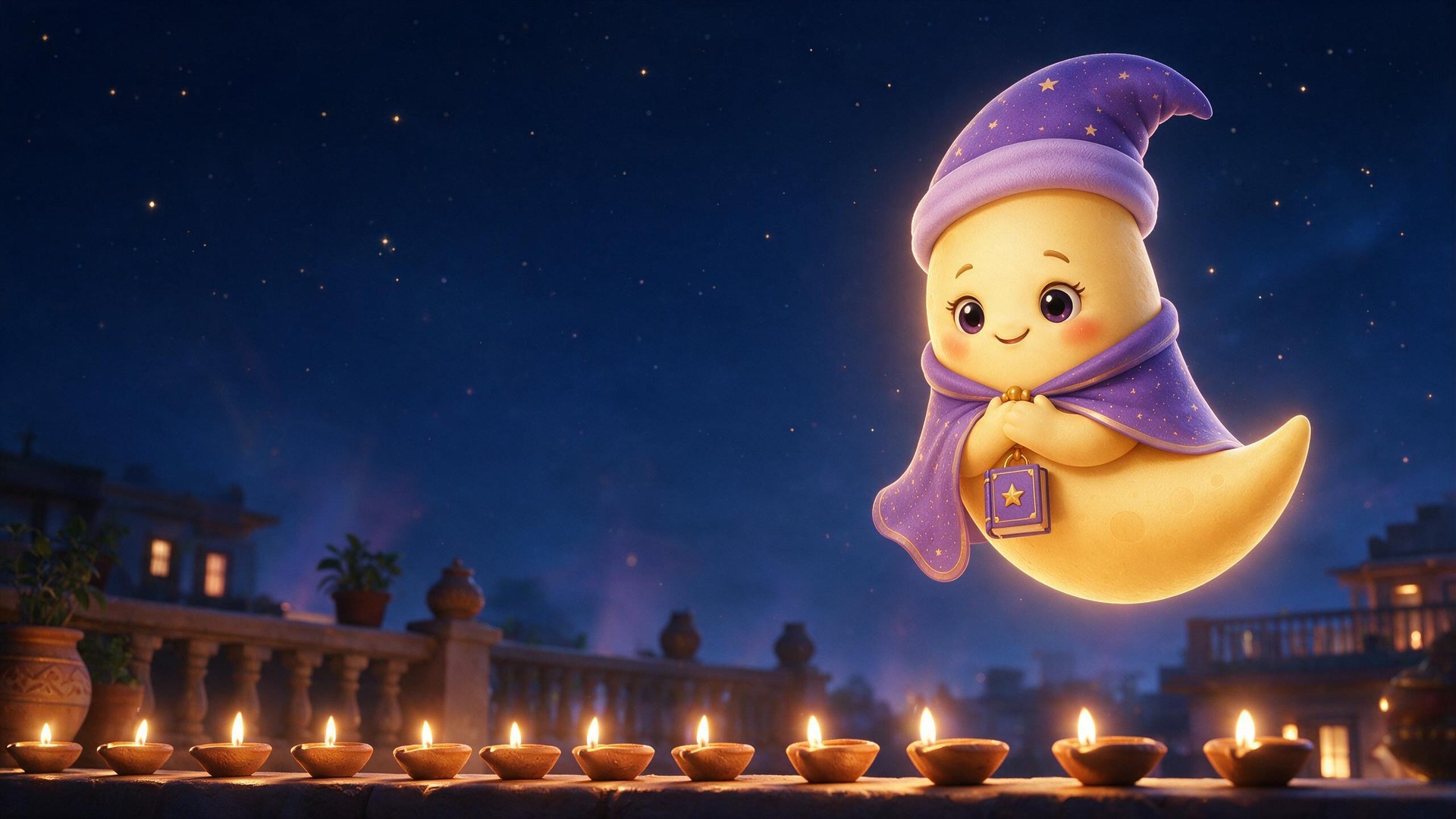
A thousand lamps,
and the reason for each one.
Diwali arrives loud. For a two-year-old it can be genuinely frightening — the bangs, the crowds, the late nights. And somewhere underneath all of it is a quiet story about people lighting lamps so someone could find their way home.
Diwali is the festival of lights. In much of India it marks Rama's return to Ayodhya after fourteen years, when townspeople lit rows of lamps so he could find his way. Elsewhere it honours Lakshmi, or Krishna, or the new financial year. All of these are correct.
The short version, for right now
If your child is asking this minute and you have thirty seconds: When Rama returned home after fourteen years away, the people of his city lit rows of small lamps so he could find his way in the dark. That is why we light lamps at Diwali.
The same festival, three different explanations.
The commonest mistake is telling a four-year-old the version written for a nine-year-old, then wondering why they wandered off.
What to say to a 3–5 year old
"People lit little lamps so someone they loved could find the way home in the dark." That is a complete story for a three-year-old, and a comforting one at bedtime.
What to say to a 6–8 year old
Now the fourteen years, the forest, the waiting. Children of this age are gripped by the length of it — fourteen years is longer than they have been alive.
What to say to a 9–12 year old
This is the age to mention that Diwali means different things in different homes, and that a Jain, Sikh or South Indian family may be marking something else entirely on the same night. Children who learn this early grow up curious rather than surprised.
Why fourteen years?
Children accept the lamps. What stops them is the number.
Rama was the eldest son of the king of Ayodhya, and he was meant to be king next. On the day before his crowning, his father was held to an old promise and Rama was sent away instead — into the forest, for fourteen years. He went without argument. His wife Sita and his brother Lakshmana went with him.
Near the end of those years, Sita was taken by Ravana, the king of Lanka. Rama crossed the sea to bring her home — helped, in the version most children meet first, by an army of monkeys and a bridge built stone by stone, with even the squirrels carrying pebbles.
Dussehra is the day Rama defeats Ravana. Diwali is twenty days later: the day the fourteen years end and he finally comes home. That is why the lamps — not a celebration of the victory, but a welcome for someone who has been away a very long time.
If your child asks who Ravana was
He had ten heads, and the usual answer is that each one was something he could not let go of. That lands better than “he was the bad one”, and it is closer to what the story is for.
In the app: Why Do We Burn Ravana on Dussehra?, Rama and the Bridge of Squirrels and Sita’s Unbroken Courage.
Diwali is five days, not one.
Most children think Diwali is the night with the lamps. It is the third of five days, and knowing the shape of it helps a child understand why the house has been busy for a week.
Dhanteras · Friday 6 November
Something new comes into the house, traditionally metal — a spoon, a small vessel. This is the day of cleaning, and of buying.
Naraka Chaturdashi, or Chhoti Diwali · Saturday 7 November
An early bath, new clothes, the first few lamps. Quieter than the night after it.
Lakshmi Puja · Sunday 8 November
The main night. Lamps in rows, rangoli at the door, and doors and windows left open so Lakshmi can find her way in. This is the night most families mean when they say “Diwali”.
Govardhan Puja, or Annakut · Tuesday 10 November
In many homes a mountain of food is offered — the story of Krishna lifting a hill to shelter his village from the rain.
Bhai Dooj · Wednesday 11 November
Sisters and brothers again, as at Raksha Bandhan, but the other way round: the sister marks her brother’s forehead, and he comes to her home to eat. What to do when they are not in the same city.
In 2026 there is no fourth-day gap to explain away and then suddenly one appears: Monday 9 November has nothing on it. Govardhan Puja lands on the Tuesday because of how the tithi falls this year. If a child asks why the week went quiet for a day, that is why.
Not every family keeps all five, and which ones matter varies a great deal by region. Some panchangs put Bhai Dooj on the Tuesday instead. If your family keeps two of them, that is Diwali too.
And then it keeps going.
Diwali is the loud one, so it is easy to miss that the fortnight after it holds three more — and two of them are quiet in a way children find easier.
Bhai Dooj · Wed 11 Nov — day five, above
Children’s Day · Sat 14 Nov — the day the grown-ups are meant to listen
Chhath Puja · Sun 15 Nov — the thank-you that goes to the setting sun first
Guru Nanak Jayanti · Tue 24 Nov — the floor where everybody sits at the same height
Dates move between calendars, and for Diwali they move by region as well. Every Indian festival date through April 2027, checked, with the reasoning →
Diwali is not one story.
In the north, Diwali is Rama’s homecoming. In much of the south it is the day Krishna defeated Narakasura, and the early-morning oil bath belongs to that story. In the west it opens the new business year, and the account books are blessed. Jain families mark the night Mahavira attained nirvana. Sikh families mark Bandi Chhor Divas, the release of Guru Hargobind and fifty-two princes from imprisonment.
If your child comes home saying their friend’s family tells it differently, they are almost certainly right. That is worth saying out loud to them.
Three things that actually work.
- Light the diyas before dark, not after. A calmer hour, and small children can help.
- Skip the loud crackers with under-fives. Sparklers and lamps carry the whole feeling without the fear.
- Tell the story before the sweets, not after. You will have their attention for approximately four more minutes.
When the crackers frighten them.
You cannot make the street quiet. You can make the inside of the house predictable.
- Tell them before, not during. “Tonight there will be loud bangs outside. They are fireworks. They stop.” A child who has been warned is startled; a child who has not been warned is frightened.
- Let them choose a room. The one furthest from the window, with the door shut, is enough. Being allowed to leave is what makes staying bearable.
- Give the noise a shape. Counting the bangs, or naming the colours from behind glass, turns a thing that happens to them into a thing they are watching.
- Keep one part of the evening the same. If there is always a story before bed, have the story — even at eleven o’clock, even short. The familiar bit is what tells a small child the night is still theirs.
And if it is genuinely too much, going home early is not a failure. Diwali is five days long. There is another evening.
Diwali stories for kids, by age.
Five Diwali stories, and which one suits which child. All are in the free library, illustrated and narrated.
- Why Do We Celebrate Diwali?
Ages 4–6 · 4 min
The shortest telling, for a child who will not sit through the long one. We light diyas to welcome goodness home. - Diwali: The Night a Thousand Lamps Were Lit
Ages 4–9 · 6 min
The full story, from the fourteen years to the lamps along the river. - Rama and the Little Squirrel’s Bridge
Ages 3–9 · 2 min
Two minutes, and the gentlest way in for a very small child. Every sincere effort matters, however small. - Why Do We Make Rangoli?
Ages 4–6 · 4 min
For the child crouched at the doorstep with a fistful of colour, asking what it is for. The pattern is a welcome, drawn where a guest will stand. - Why Do We Burn Ravana on Dussehra?
Ages 4–6 · 3 min
What happens twenty days before, on Dussehra — and why the effigy need not frighten anyone.
The story itself.
Illustrated, narrated, and free in the StoryVeda library — in English, Hindi, Hinglish, Tamil, Telugu, Bengali or Marathi.
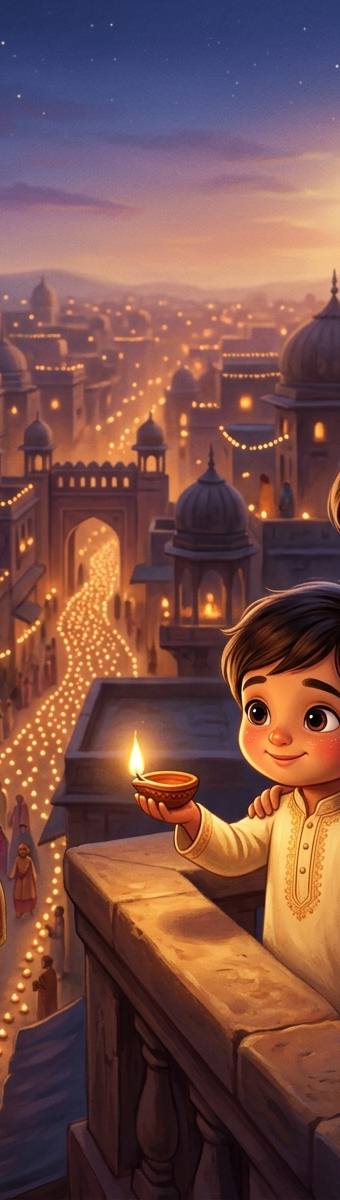
Diwali: The Night a Thousand Lamps Were Lit
Festivals of Bharat · ages 4–9 · 7 min
Diwali: The Night a Thousand Lamps Were Lit
“Light always wins over darkness — and love always finds its way home.”
 Listen on the appFree · Google Play
“Diwali: The Night a Thousand Lamps Were Lit”
This Diwali story is in StoryVeda's Festivals of Bharat collection — narrated, illustrated, and available in English, Hindi, Hinglish, Tamil, Telugu, Bengali or Marathi. It is in the free library.
Festival stories arrive the week they matter, not months later. That is the whole reason the collection exists.
Diwali, briefly answered.
How do I explain Diwali to a child?
Start with one sentence and stop there: “People light little lamps so someone they love can find their way home.” If they ask more, add that he had been away a very long time, and everyone was glad he was back. Keep Ravana out of it until they ask — a child under six does not need the battle to enjoy the lamps.
What is the Diwali story for kids?
When Rama returned home after fourteen years away, the people of his city lit rows of small lamps so he could find his way in the dark. That is why we light lamps at Diwali.
When is Diwali in 2026?
Sunday, 8 November 2026.
How do I explain Diwali to a 3-year-old?
"People light little lamps so someone they love can find their way home." One sentence is enough at that age, and it works beautifully at bedtime.
How can we celebrate Diwali calmly with a toddler?
Light diyas before dark, use sparklers rather than loud crackers, keep the evening short, and tell the story before the sweets arrive.
What is the history of Diwali for kids?
Rama, the eldest prince of Ayodhya, was sent to the forest for fourteen years. When he returned, the people lit rows of lamps so he could find his way in the dark. Diwali is that homecoming. Other parts of India mark other stories on the same night, and all of them are correct.
How do I explain Diwali to a 4-year-old?
One sentence is enough: “People light little lamps so someone they love can find their way home.” Save the fourteen years for when they are six or seven — at four, the length of it means nothing.
Why is Diwali celebrated for five days?
Each day marks something different — Dhanteras, Chhoti Diwali, Lakshmi Puja, Govardhan Puja and Bhai Dooj. The lamp-lighting night most people picture is the third. Many families keep only two or three, and that is normal.
More festivals: Raksha Bandhan · Krishna Janmashtami · Ganesh Chaturthi · Navratri
One email, the evening before each festival.
The story told simply, at three different ages, ready to read aloud at bedtime. Eight or ten a year. Nothing else.
Never more than one a fortnight, and one click to stop. We don’t share your address with anyone.