The quiet half
of StoryVeda.
Every night ends the same way, whatever the story was. The lights go down, the voice gets slower, and something settles. This is the part of the app that isn’t a story at all.
Prayers your grandmother knew. Breathing a four-year-old can actually do. A small quiet corner in Hindi for the evenings when a feeling got too big.
Most children’s meditation is made in English, by adults, for adults who happen to be small. A body scan will lose a four-year-old in under a minute. So none of this is a shortened adult practice — it was written for children, in the languages they are spoken to in, and paced for a child who is already tired.
And every prayer carries two things a recitation video never gives you: a transliteration, so a parent who doesn’t read Devanagari can still follow along, and a plain-English meaning written for a child — so when they ask what it means, you have an answer.
Learn a prayer in 7 days.
One prayer. Seven short evenings. By the end of the week your child can say it — and knows what it means.
Most of us learned a prayer by standing next to someone who already knew it. That is harder now: the grandmother is in another city, the evening is shorter, and nobody wants to turn bedtime into a lesson.
So this does it the slow way, a few minutes at a time, in the last quiet part of the day.
Evening one
Your child just listens. Nothing to repeat, nothing to get right.
Evenings two to four
A line at a time, said back slowly. Short enough that it never becomes homework.
Evenings five and six
The lines join up. This is usually the evening a parent realises they know it too.
Evening seven
The whole prayer, on their own — and the meaning, in words a child can use.
It is a week, not a course. Miss an evening and nothing resets. Come back on Thursday and it carries on where it stopped.
The ones you half remember.
Each with its Sanskrit recitation, a transliteration you can read, and a meaning pitched at a child.

Gayatri Mantra
For a bright, clear mind.

Shanti Mantra
Peace, asked for three times over.

Ganesha Mantras
Before something new, or a little frightening.
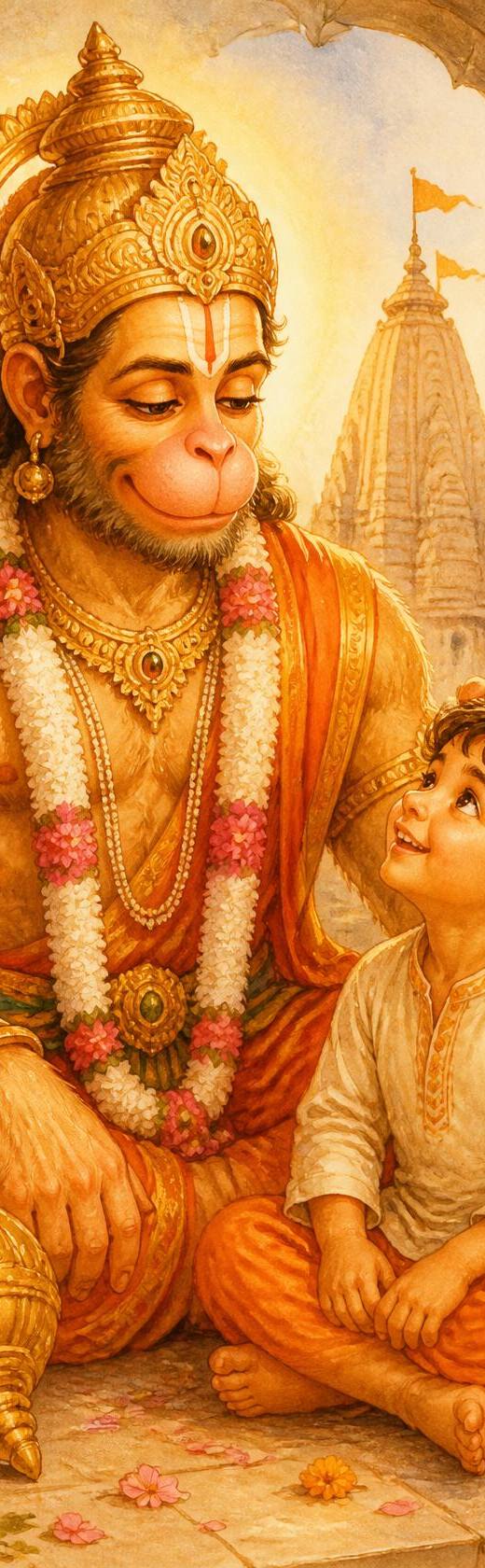
Hanuman Chalisa
For courage. The first one most children learn.

Saraswati Vandana
For learning, and the night before an exam.

Morning Prayers
For the start of the day, not the end.

Vakratunda Mahakaya
Four lines. A good first shloka.

Wisdom Shlokas for Kids
Short verses a child holds easily.
Also inside: Peaceful Bedtime Chants, Karagre Vasate Lakshmi, Twameva Mata, Simple Sanskrit Shlokas, Vishnu Sahasranamam, Mahamrityunjaya, Guru Brahma, Vidya Mantras, Aditya Hridayam and Lingashtakam. All in English, Hindi, Hinglish and Sanskrit recitation.
Offered as heritage, not instruction. Nothing here says one family’s practice is the correct one, and the breathing, visualisation and affirmation sections carry no religious content at all. Use as much or as little as suits your home.
Five chants, and what they actually mean.
This is the whole text a parent sees in the app. Nothing withheld, nothing mystified.
Om · 2:50 min
Auuum…
Om is called the sound of the universe. Chanting it slowly makes the whole body feel quiet.
Gayatri Mantra · 11:10 min
Om bhur bhu-vah sva-ha, tat sa-vi-tur va-ren-yam, bhar-go de-vas-ya dhi-ma-hi, dhi-yo yo nah pra-cho-da-yat
It asks the morning sun to shine its light on your mind — so thoughts grow bright, kind and clear.
Om Namah Shivaya · 2:50 min
Om Na-mah Shi-va-ya
“I bow to the kind and peaceful one.” A reminder that calm and strength live inside you.
Hare Krishna · 8:40 min
Ha-re Krish-na Ha-re Krish-na, Krish-na Krish-na Ha-re Ha-re, Ha-re Ra-ma Ha-re Ra-ma, Ra-ma Ra-ma Ha-re Ha-re
It calls to Krishna and Rama by name, like calling dear friends, and fills the heart with love.
Om Mani Padme Hum · 1:49 min
Om Ma-ni Pad-me Hum
“The jewel in the lotus” — chanted to fill the heart with compassion for everyone, everywhere.
A quiet corner, in their own language.
Seven guided sessions in Hindi, each short enough for a child who is already tired. Not meditation as an exercise — meditation as a way of putting the day down.
They are about the things that actually keep a child awake: anger that has not gone anywhere, a day that was too exciting, a body that will not be still. Each sits over a musical bed recorded for it — a diya-lit raga, a monsoon veena, a low Om drone.
Om
A slow, steady Om to settle a racing mind. The simplest place to start.
Baadal — the cloud
Drifting with the clouds, for a child who cannot switch off after an exciting day.
Gubbara — the balloon
Breathing like a balloon filling and emptying. Children take to this one fastest.
Gussa — the anger
What to do with a feeling that is too big. For the evening after a hard day.
Haathi — the elephant
Slow, heavy, grounded steps. Good for a child who feels jittery or scattered.
Dhanyavaad — thank you
A gratitude practice, spoken gently rather than asked as a question.
Sone ki tayyari
Getting ready to sleep — the last one of the night, every night.
Breathing a child will actually do.
Two minutes, with something to picture or trace — because “take a deep breath” has never once worked on a four-year-old.
Bunny Breathing
Sniff, sniff, sniff like a little bunny.
1½ min · ages 2–8
Box Breathing
Breathe around the four sides of a square.
2 min · ages 3–12
Rainbow Breathing
Draw a rainbow in the air, one colour per breath.
1¾ min · ages 3–10
Star Breathing
Trace a five-pointed star with a finger.
1¾ min · ages 4–12
Ocean Wave Breathing
Breathe like waves arriving and leaving.
2 min · ages 5–12
Belly Breathing
A hand on the tummy, watching it rise and fall.
2 min · ages 3–12
Five minutes, eyes closed.
Somewhere between a story and a meditation, and the thing that most often finishes the evening. In English and Hindi.
Chandamama's Moonbeam Slide
Slide down a silver moonbeam with Veda Moon.
Nani's Night Garden
Rest in a warm garden full of jasmine and fireflies.
Flying with Hanuman
Ride gently on Hanuman's shoulder across the night sky.
The Little Boat
Float down a calm, starlit river towards sleep.
Cloud Float
Drift on a soft cloud to somewhere peaceful.
Gratitude Garden
Three good things to think about before sleep.
Kind sentences, said out loud.
Not slogans. Short, specific, unembarrassing things for a child to hear at the end of a day that did not go well.

Sleep Affirmations
Quiet sentences for a body that won’t settle.

Kindness Affirmations
After a hard day, or a fight with a sibling.

Courage Affirmations
For the night before something new.

Gratitude Prayers
Thank you, said out loud, before lights off.
Alongside them: Family Blessings, said over a child the way a grandmother would, and Krishna Bhajans sung slowly enough to join in with.
All of it, inside the app.
Shanti Corner and the wind-down library live in the app’s Magic Corner, beside the gratitude journal and the Magic Word Vault.
The breathing exercises, the chants and the Shanti Corner sessions are free. The full prayer and shloka library, every language and Learn a Prayer in 7 Days come with premium.

Related: Less screen time, more story time · Seven languages · Read it in your own voice