Baisakhi Story for Kids
— The Golden Harvest.
Most festivals a child meets are about gods and battles. This one is about wheat. It is the day the fields of Punjab turn gold, the year’s work is finished, and everybody dances in a field about it.
Baisakhi is three things at once, and they sit together comfortably: it is the day the wheat harvest is ready, it is the Punjabi new year, and for Sikh families it is the day in 1699 when Guru Gobind Singh founded the Khalsa. Which of the three matters most depends on whose house you are in.
The short version, for right now
“The farmers worked all year, and today the wheat is finally ready. So everyone stops, and eats together, and dances.” For a four-year-old that is the whole festival, and it is a genuinely lovely one to hand them.
The same day, three different explanations.
What to say to a 4–5 year old
“The wheat that makes our roti is ready today, and everyone is so pleased they are dancing in the field.” Point at a chapati. That is the lesson, and it lands immediately.
What to say to a 6–8 year old
Now the new year, and the shape of a farming year — sowing, waiting through the cold, and the enormous relief of a crop that came good. This is the age at which children start to grasp that food does not begin in a shop.
What to say to a 9–12 year old
Old enough for 1699: Guru Gobind Singh gathered an enormous crowd at Anandpur Sahib and founded the Khalsa on this day. Told carefully, it is a story about people choosing to stand up and be counted, and it belongs beside the harvest rather than replacing it.
Three things that actually work.
- Start with the roti, not the history. Let them hold a handful of wheat or atta. A harvest festival explained through a field they have never seen stays abstract; explained through dinner, it does not.
- Dance badly, on purpose. Bhangra is the rare festival tradition that asks nothing of a two-year-old except enthusiasm. Five minutes in the sitting room is a complete observance.
- Give something away. Sharing the harvest is the point of the day, and a child who packs one thing for someone else has understood Baisakhi better than one who has been told about it.
The story itself.
Illustrated, narrated and free in the StoryVeda library.
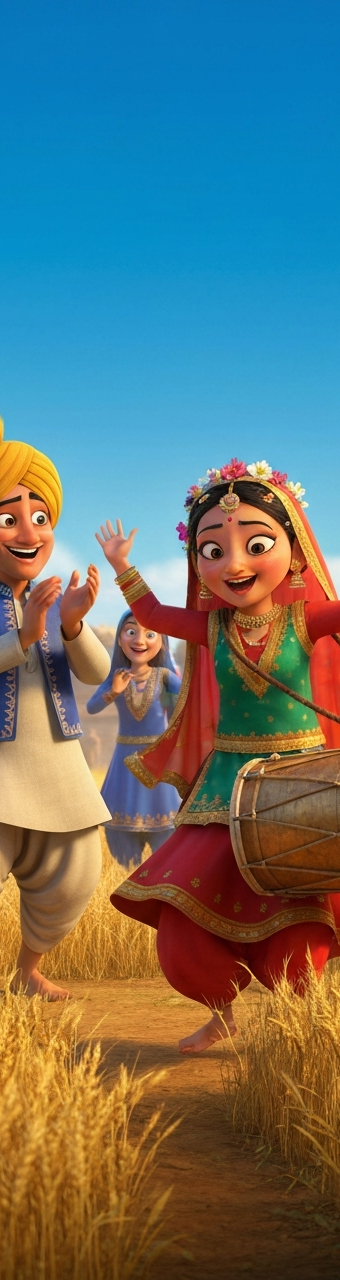
Baisakhi: The Golden Harvest Dance
“When you work hard, give thanks, and share what you have — there is always enough for everyone.”
 Listen on the appFree · Google Play
Baisakhi, briefly answered.
What is Baisakhi in simple words for kids?
Baisakhi is the day the wheat harvest is ready in Punjab. Farmers have worked all year for it, so the whole village dances and eats together. It is also the Punjabi new year, and for Sikh families it marks the founding of the Khalsa in 1699.
When is Baisakhi celebrated?
Baisakhi falls on 13 or 14 April each year, depending on the solar calendar. In 2027 it is Wednesday, 14 April.
Why do people dance Bhangra on Baisakhi?
Bhangra began as a harvest dance — the movements come from the actions of farming, sowing and cutting the crop. It is danced because the year’s work has come good, which is a thing worth telling a child directly.
How do I explain Baisakhi to a child who does not live in Punjab?
Start with food. Every roti on the table came from wheat somebody grew, and Baisakhi is the day that work is finished and everyone says thank you for it. A child who has never seen a field understands a harvest through the chapati in their hand.
More festivals: Diwali · Navratri · Raksha Bandhan · Halloween