Halloween, explained
— for Indian families.
In a great many Indian buildings there is now one evening in October when the lift is full of small skeletons. If you did not grow up with this, it can be a puzzling thing to be handed. It is also, underneath the plastic teeth, quite a simple idea.
Halloween is an evening when children dress up, knock on their neighbours’ doors, and are given sweets. That is the whole of it. The costumes are often ghosts and skeletons because the festival began as a night when people believed the boundary between the living and the dead thinned — but for a modern child it is a dressing-up evening with a bag.
The short version, for right now
“One evening a year, children dress up as something else and go round asking the neighbours for sweets. The neighbours know it is coming, and they have the sweets ready.” For most children under six, that is the entire festival and it needs nothing added.
The same evening, three different explanations.
What to say to a 3–5 year old
“It is a dressing-up day. You can be anything you like, and people give you sweets.” Leave the ghosts out entirely. At this age the costume itself is the whole appeal.
What to say to a 6–8 year old
Now the ghosts can come in, framed as pretend. This is also the age to explain that it is not an Indian festival — it came from Ireland and Scotland, went to America, and arrived here through films and building WhatsApp groups.
What to say to a 9–12 year old
Old enough for the real history: a harvest festival called Samhain, marking the end of the light half of the year, when people lit fires and wore disguises so that wandering spirits would not recognise them. Children of this age tend to find the actual origin far more interesting than the sweets.
When a small child finds it frightening.
Plenty do, and there is nothing at all wrong with that. Under about six, a child does not reliably hold on to the idea that a mask is a mask.
- Let them watch someone put the mask on. Seeing the face go under the mask does more than any explanation.
- Name the child inside. “That is Aarav in a mask” is the single most useful sentence of the evening.
- A kind costume counts. Nobody is obliged to be frightening. A tiger, an astronaut or a laddoo is a perfectly good Halloween costume.
- Two doors is a full Halloween. If they want to go home after the second flat, that is not a shortened evening — it is their evening.
And if your family would rather not mark it at all, a child can be told that straightforwardly. “We do not do this one, we do Diwali” is a complete answer and needs no defending.
The story itself.
Illustrated, narrated and free in the StoryVeda library.
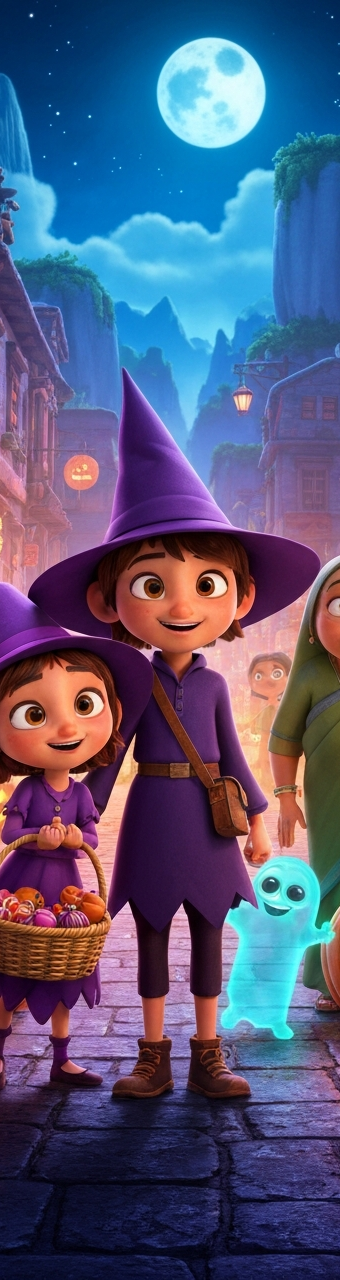
Halloween: Dadi and the Ghost Children
“Every celebration is people opening their doors to each other.”
 Listen on the appFree · Google Play
Mia lives in a building full of families from everywhere. On Halloween she has to explain the whole business to her dadi, who is visiting from Ahmedabad and is not persuaded. Dadi insists on coming along. What she sees changes her mind — and she makes a decision about next year.
Halloween, briefly answered.
Should Indian children celebrate Halloween?
That is entirely a family’s own decision, and there is no wrong answer. Many Indian families join in because the children in their building are doing it; many others do not, and mark Diwali a week later instead. Both are fine, and a child can be told plainly that different homes choose differently.
How do I explain Halloween to a child who is frightened by it?
Separate the costume from the person. “That is Aarav in a mask. Underneath, he is still Aarav.” Young children lose track of that, and being reminded of it is usually enough. Skip the horror decorations entirely under about six.
What is a gentle Halloween story for young children?
StoryVeda has one called “Halloween: Dadi and the Ghost Children”, written for ages 3–12 and about five minutes long. It is about a grandmother from Ahmedabad who is deeply suspicious of the whole business, goes along anyway, and changes her mind.